
Stories over statistics
There's a banner outside a local school that makes me want to scream, quietly.
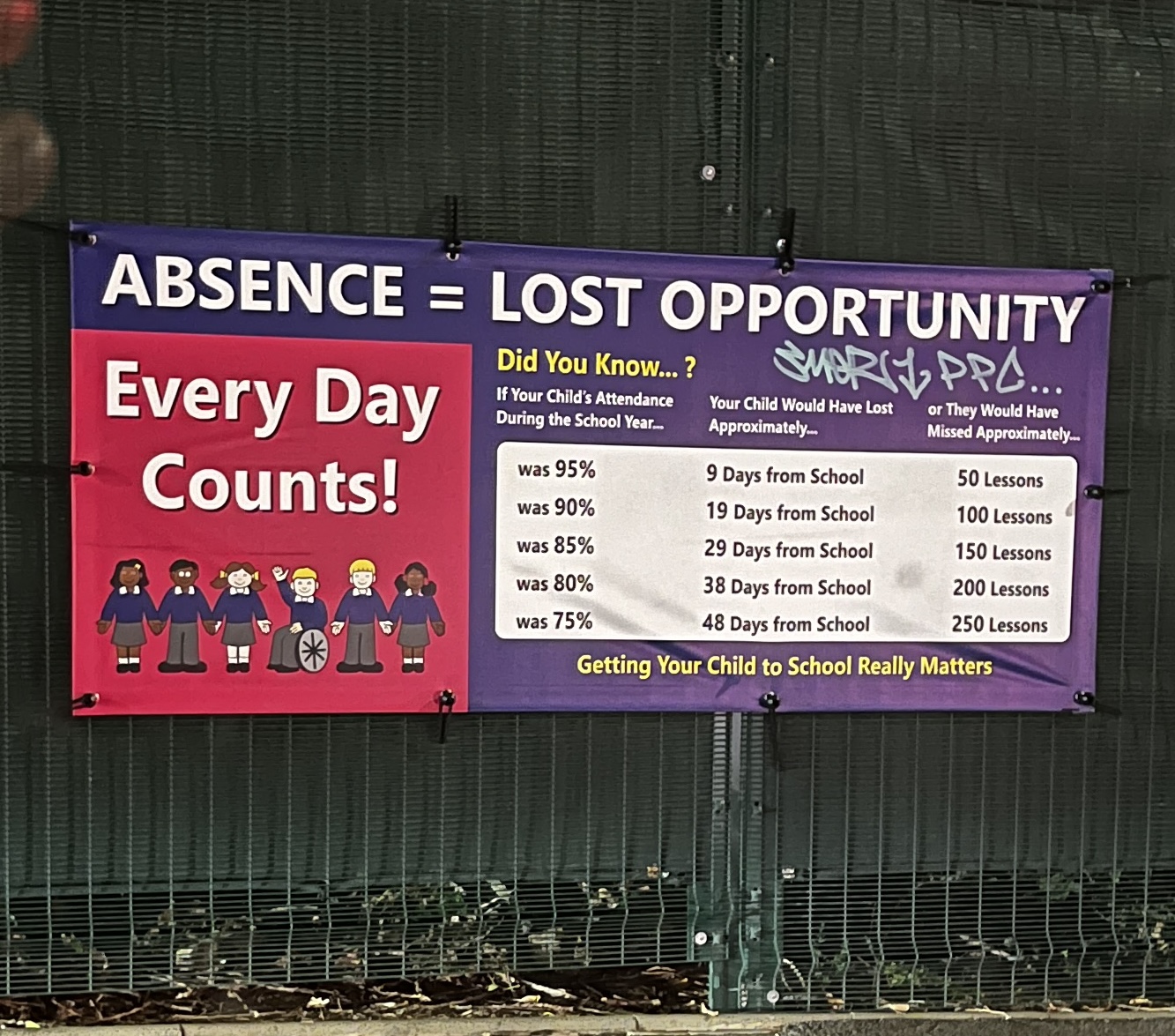
I took a photo of it, and it’s been on my mind ever since. It's one of those professionally printed jobs, all corporate clipart and cheerful fonts, cable tied to the railings where every parent has to see it on the way in. Big bold letters at the top read "ABSENCE = LOST OPPORTUNITY". Then a table. A beautiful, pristine table of statistics showing you exactly how many days and lessons your child loses at each attendance percentage. 95% attendance? 9 days lost, 50 lessons missed. 75% attendance? 48 days, 250 lessons. The math is impeccable. More robust than the autumn budget.
The message is crystal clear. But sadly, I think it could well be completely and utterly useless.
I’ve seen parents shuffle past it without a glance, and it made me think this is why we're losing. Not losing the attendance battle – though we probably are too. I think we’re losing something bigger. The battle for trust. The battle for engagement. The battle to make people give a damn about the things that actually matter for their kids, their communities, their lives.
Because whilst we're cable tying statistics to school railings, someone else is telling stories. Better stories. Stories that make people feel something. Stories that make them angry, hopeful, scared, proud – stories that move them to action. Right now, we mostly call those people populists. And perhaps we can learn from them.
The bit where I don't become a fascist
Before you jump on the populism=fascism high horse, I'm not suggesting we start scapegoating immigrants or inventing culture wars to drive up school attendance. But here's the unfortunate truth at present; populist movements have figured out something that public services seem to have entirely forgotten. They understand that humans don't really make decisions based on facts. We make them based on stories. Stories about who we are, who we want to be, who's threatening that, and what we need to do about it.
Think about the last populist campaign that really landed in your world. Brexit, Trump, any of them. Now think about the campaigns against them. The Remain campaign in the UK was essentially a massive Excel spreadsheet of a with a flag on it. GDP projections. Trade forecasts. Expert testimony. All of it true. None of it compelling. Now the campaign that scarily seems to be cutting through today only involves the flags, and it’s edging us closer to the wrong side of history again.
The crooks fuelling the leave campaign won. “Take back control" cut through because it told people a story about themselves. You were someone who'd lost something precious. Someone who deserved better. Someone who could reclaim what was rightfully yours. Three words. No statistics. No asterisks. Just a story you could slot yourself into. And people did.
Meanwhile, public services are still designing campaigns like that attendance banner. Like the council tax letters that read like legal threats. Like the benefits forms that require a PhD to navigate. Like the planning consultations that inspire exactly nobody to turn up.
We're speaking a language that nobody actually speaks.
What populism knows about your brain
There's a reason this works, and it's not because people are stupid. In fact I think trying to counter far-right extremism on the premise of people just being stupid or gullible is incredibly dangerous. It's because of how we're wired. Jonathan Haidt, an American social psychologist, talks about the rider and the elephant. I don’t love the analogy, but I think it paints a solid picture. The rider is your rational brain, the bit that can process statistics about attendance rates. The elephant is everything else. The emotion, intuition, instinct, identity. The elephant is about 40 times bigger than the rider. And the key bit is that the elephant goes where it wants to go, and the rider just makes up stories afterwards to justify it.
Populists speak directly to the elephant. They tell it where to go with stories, symbols, enemies, and identities. They make you feel first, then let you reverse engineer the logic later. Even if logic is a term applied loosely! Public services speak to the rider. They present facts and expect behaviour change to follow naturally. Then they're baffled when it doesn't work. When people don't attend their appointments, or miss their bin days, or fail to engage with consultations, or don't send their kids to school every single day.
There’s lots of study that amplifies this in the political context too. George Lakoff spent his career showing how conservatives in the US understood framing in ways that liberals didn't. They weren't just better at communication, they had a fundamentally different understanding of how language shapes thought. Take something like the framing of "Tax relief”, which isn't neutral. It frames taxation as something you need relief from. Or “Death tax" instead of "inheritance tax".
This works both ways too, showing it can be used for civic good! Take something like “Climate crisis” instead of “Climate “change”. It’s emotive, and clear and demands attention and opinion.
These things aren't just spin. They're the cognitive architecture that build the frame through which people see the issue. And once the frame is set, facts that don't fit generally get rejected. Truthful or otherwise. It’s mega powerful.
The banner outside the school has no frame except "school attendance is important". Which is obvious right? But the why? For who? The story? It’s all missing.
What the banner could have said
Imagine if we'd designed that banner like a populist campaign. Not with lies or scapegoats, but with an actual story about who these kids are and what they're building. Why school might just be the most important place for them to be right now.
What if it said: "Every day they're here, they're becoming who they'll be."
Or if we’re wedded to the negative slant: “When they’re not here, they’re missing out on who they could become.”
Then maybe a small line underneath: "That's why the days matter”. No table. No percentages. No arithmetic of lost lessons. Just a story about identity and transformation. About your child becoming themselves. About presence, not absence. Sure, you could add in a few numbers to satisfy the likely academy trust neoliberal leadership pretenders.
Or we could even go bigger! What if the whole thing was boosted with real visuals? Lean into the charity campaign aesthetic. Photos of actual kids from the school doing the things they love. Playing football. Making a mess with paints. Learning to code. Performing in the school play. Laughing with their friends. With a simple line: "This is what happens here. Don’t let them miss out”.
The implicit frame of how school isn't about lessons gets lost in the table of statistics. School is about life being lived. Our kids aren’t statistics or percentages, or at least we can try and hold off a little longer until when they sadly might become one. They're becoming themselves, and this is where it happens.
Would it work? I don't know. But I know the current banner isn't working. I know because I watched parents walk straight past it. And those are likely the parents that are bringing their kids to school anyway.
The pattern everywhere
This isn't just about school banners. It's everywhere you look in public services.
When councils try to engage residents in consultations, they send out 40 page PDFs of planning documents and wonder why only three people named John respond. When the DWP designs benefits systems, they create processes so hostile that even entitled claimants give up. When the NHS tries to reduce missed appointments, they send threatening letters about wasted resources. All of it speaks to the rider. None of it speaks to the elephant, as Haidt would claim.
Meanwhile, populists are building entire movements by doing the opposite. They tell stories about communities left behind. About ordinary people betrayed by elites. About taking back control, making your country great again, putting you first. The facts often don't matter because the story is so compelling.
And here's the thing that keeps me up at night thinking more and more lately – they've proven it works. Not just at the polling stations, though obviously there. But in changing behaviour, building movements, getting people to actually do things. To show up. To care. To act. We've seen what happens when you treat people like the complex, emotional, story driven creatures they are. You get Brexit. You get Trump. You get movements that reshape entire countries in a race to the bottom, masquerading as a rightful climb to the top, by the 0.1% that will always remain out of reach.
So why on earth are we still designing public services like people are rational actors who just need the right information?
The legitimate fear
I can hear the objection already. Using emotion to drive behaviour is manipulation. It’s propaganda on the road to authoritarianism. Yes there's a tension here. The techniques populists use can absolutely be weaponised. They often are weaponised. Creating enemies. Stoking fear. Building tribal identities that exclude and harm.
But here's what I think we get really wrong, or at least overlook. We're already doing emotion based governance. We're just doing it badly and accidentally. We’re not designing it. The attendance banner is trying to create anxiety. It’s trying to instil in you the fear of your child falling behind. Shaming you about being a bad parent. It's still manipulation, it's just ineffective emotional manipulation dressed up as neutral information. As facts.
The council tax letter that threatens court action is built on emotion. The benefits form designed to make you feel small and scrutinised is emotion. The planning consultation that makes you feel like your voice doesn't matter is emotion. We're already playing the game. We're just losing it to people who understand the rules better than we do.
The question isn't whether to use narrative and emotion in public services. The question is whether we'll learn to use them in service of human good rather than leaving them to those who'll use them for division and hate.
Going with the grain
I love an adjacent analogy. Peter Latz, the landscape architect, talks about transformation not needing to erase the past. You have to understand what remains and work with it.
I think about this a lot in the context of organisations. We can't just rebuild the way institutions communicate and start fresh. But we can start working with the grain of how humans actually work, rather than constantly against it.
That means designing services and propositions that understand:
- Identity comes before information
- Stories come before statistics
- Emotion comes before evidence
- Belonging comes before behaviour change
It means testing our work by asking what the story really is. Not the policy intent or the service outcome, the actual human story. Who is the person in this story? What do they need? What's stopping them? What becomes possible if they engage? It means accepting that the rational case for something, no matter how airtight it might seem, will never be enough. Because humans aren't rational. We're rationalising. We make decisions in our gut and our hearts, then use our minds to justify them afterwards.
The populists know this. The multi-national brands know this. Capitalism knows this! The movements that actually change behaviour know this. It's time public services learned it too.
The banner I want to see
I don't know what the right answer is for that attendance banner. Maybe it's the identity framing I mused about earlier. Maybe it's something completely different. Maybe it's not a banner at all, maybe it's more opportunities for conversations, or stories from other parents, or something that hasn't been thought of yet. Maybe it’s something wildly adjacent, like an intervention from government through a cap on holiday prices out of term time (just a hunch).
But I know what it's not. It's not a table of percentages. It's not maths. It's not abstract statistics about lost lessons that treat children like units of production. Because that's not how change happens. That's not how humans work. It’s just how capitalism has us believe things should work.
Change happens gradually, then suddenly. It happens when someone tells you a story that makes you see yourself differently. It happens when you feel something shift. When you want to be part of something. When you understand what's at stake in a way that matters to you, not just in a way that's technically true.
The populists have shown us this works at scale. They've proven that movements can be built, behaviour can be changed, and worlds can be reshaped by people who understand how to speak to the elephants inside of us, not the riders.
We just need to decide whether those of us trying to build better institutions, better services, better communities, better futures, will learn that lesson. Or whether we'll keep cable tying statistics to railings and wondering why nobody's listening.
by KJ