
Offer Hunters
I’m always at the shops. Always one ingredient short of dinner. Always leaving with more than I planned to buy. This makes me something of an expert in supermarket behaviour—or at least in how they keep me coming back.
Lately, I’ve noticed something curious: the supermarket loyalty scheme offers (you know the ones) have started changing more frequently. Not just weekly or daily – sometimes it feels like they’re shifting by the hour. Stealthily nudging me to adjust what I buy. Everyone loves a good deal, especially when it’s for something you already need. But we know the game: offers change, prices fluctuate, and ultimately, ‘Big Supermarket’ always wins.
What’s different now is the speed. The pace of change. Offers seem to vanish or reappear quicker than ever, and that got me wondering – what’s going on behind the scenes?
In my day job, I help organisations untangle themselves so they can adapt, evolve, and deliver better outcomes for people and communities. A lot of that work involves ‘discovery’. It’s what I like to think of as investigative journalism for organisations. You step into the shoes of a cultural anthropologist, observing how people act, think, and adapt in messy, overlapping contexts.
A big part of that puzzle? Understanding how technology and data flows through the organisation.
Back in the supermarket, I couldn’t help but imagine the infrastructure making all of this possible: systems analysing buying habits, crunching numbers at scale, and deploying offers that feel just a little too well-timed. It’s mundane magic at work! Tech so integrated into our daily lives that we don’t even think about it until it starts shifting our habits.
So while I’m picking up that one last ingredient, I’m also thinking about what’s really on offer. The way tech and data shape even the most routine parts of our lives – and how understanding those systems can help us navigate the small but constant shifts they create.
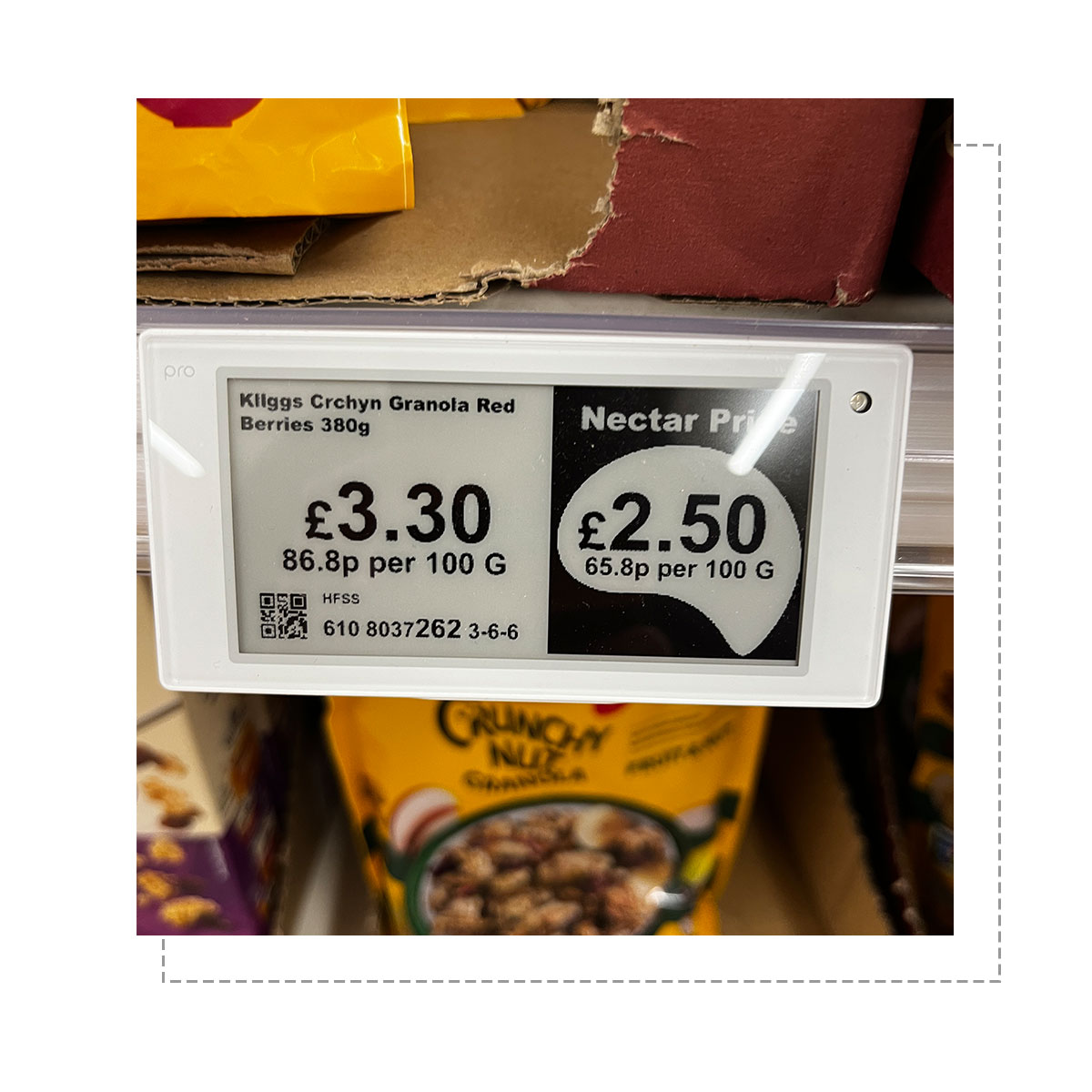
At first glance this image of a pricing label looks pretty standard right? We’ve become used to this proposition. You scan for the item along the aisle, see what prices are looking like as they all adorn this fairly uniform setup.
But if you squint, you’ll be able to almost notice pixels! Without pixel peeping, you’d be hard pressed to tell the difference between this and a regular printed paper label. What we have here though, is a tiny little e-ink display. The same tech you’d more expect to find in your kindle device. So that’s one piece of the puzzle. Here's a 'standard' paper label for comparison.
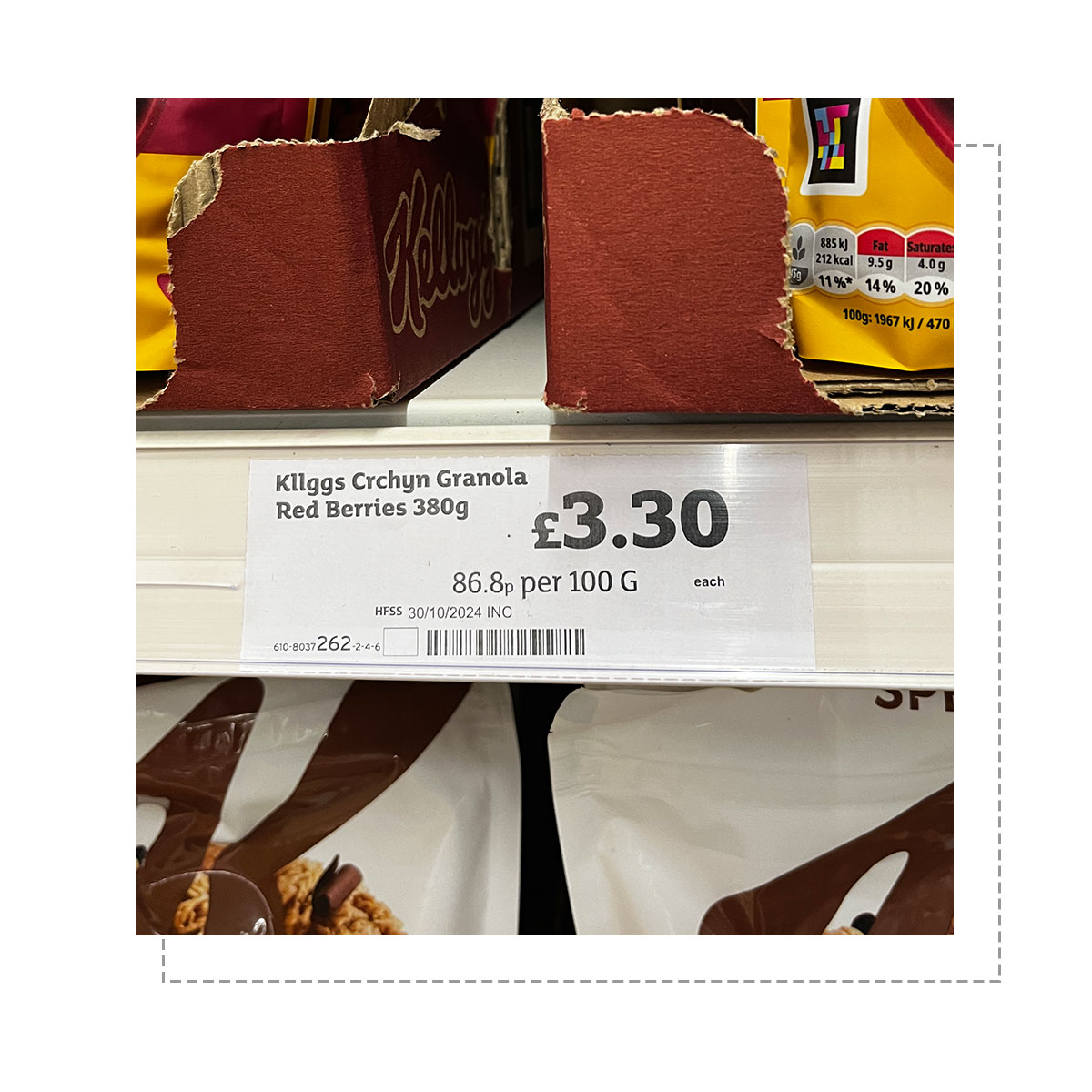
That means e-ink displays are a cheap enough commodity now for ‘Big Supermarket’ to have them littered across an entire store. What’s more, they must also be easily networked and low powered enough to fit the lifecycle of changing prices in groceries and FMCG goods.
Digging a bit deeper down the e-ink rabbit hole, I learned they only use electricity when changing the display, so I imagine using them to show prices could be even more efficient in the long run than paper. Wild. This is all according to Reddit, so take with a pinch of salt.
So what does all this mean?
Well for a start, this gives ‘Big Supermarket’ a mega leap up in terms of the data currency and speed of pricing feedback loops. You could imagine a scenario where a product starts trending at the checkout, and almost instantly an offer on a competing product appears on the shelves to counter it. A bit like surge pricing mechanisms deployed by the likes of Uber.
Supermarkets have always had a decent grip on consumer data, but this gives them the ability to act on micro trends, without the human bottleneck (i.e. the lovely people that would ordinarily have to whip round the aisles to change every individual label).
There are myriad of tech bro scenarios that you could imagine deploying using this tech. But what about some more interesting moments of intervention, for the public good?
Toward state controlled pricing for public health interventions
In Italy, there’s a state-regulated price for espresso of roughly £1. It’s a cultural cornerstone. What’s amazing is that this price is respected even though there isn't a strict legal regulation enforcing the exact value.
Here in the UK, there’s a soft drinks industry levy more widely known as the ‘sugar tax’ that aims to reduce the amount of sugar in drinks and combat obesity. There’s a causal chain here that the policy is trying to counter.
These measures are very different, but essentially doing the same thing. Trying to affect or control price – using that as a lever. A lever to protect culture and heritage (Italy) or to make business pay a premium to supply unhealthy goods (UK).
But what if we took this further? The Consumer Price Index (CPI) basket of goods is roughly the accepted ‘standard’ for a decent proxy of inflation. Let’s take this basket of goods, mostly the food necessities, and mandate their price at a state level.
Using our ‘Big Supermarket’ tech as an enabler, these predefined goods would all be tracked and adjusted in real time. Maintaining a price equilibrium of sorts. You could walk into any shop anywhere in the UK and know that you’d be able to fill your basket with those items for the regulated price. Let’s call it the ‘minimum viable nourishment’ deal.
Public health bodies would have access to and be able to own and manipulate these wireless shelf pricing labels, all in the interest of public good.
It might not save us from the cost of living crisis, but every little helps.
by KJ